

Running an online store is exciting. But if you want more people to find your products, you need to get good at SEO (Search Engine Optimization) . Simply, SEO for E-commerce helps your store appear on Google when people search for things you sell. If your store shows up higher, more people will visit, which means more chances to make sales.
In this blog, we’ll cover everything you need to know to boost your e-commerce store with SEO!
What is SEO and Why is it Important?
SEO stands for Search Engine Optimization. It’s the process of making your website more visible on search engines like Google when people search for things you offer, like products, services, or information.
How Does SEO Work?
Search engines like Google scan (or “crawl”) websites to figure out what they’re about. Then they decide which pages to show first when someone types a search. Google decides who to show first based on many things, like:
- How useful your page is
- How fast does your site load
- Whether your site works well on phones
- How many other sites link to your store
Good SEO tells Google: “Hey! My page is helpful, relevant, and trustworthy – show it to people!”
The better your SEO, the higher your site ranks. And people are more likely to click the top results.
Why is SEO Important for E-commerce?
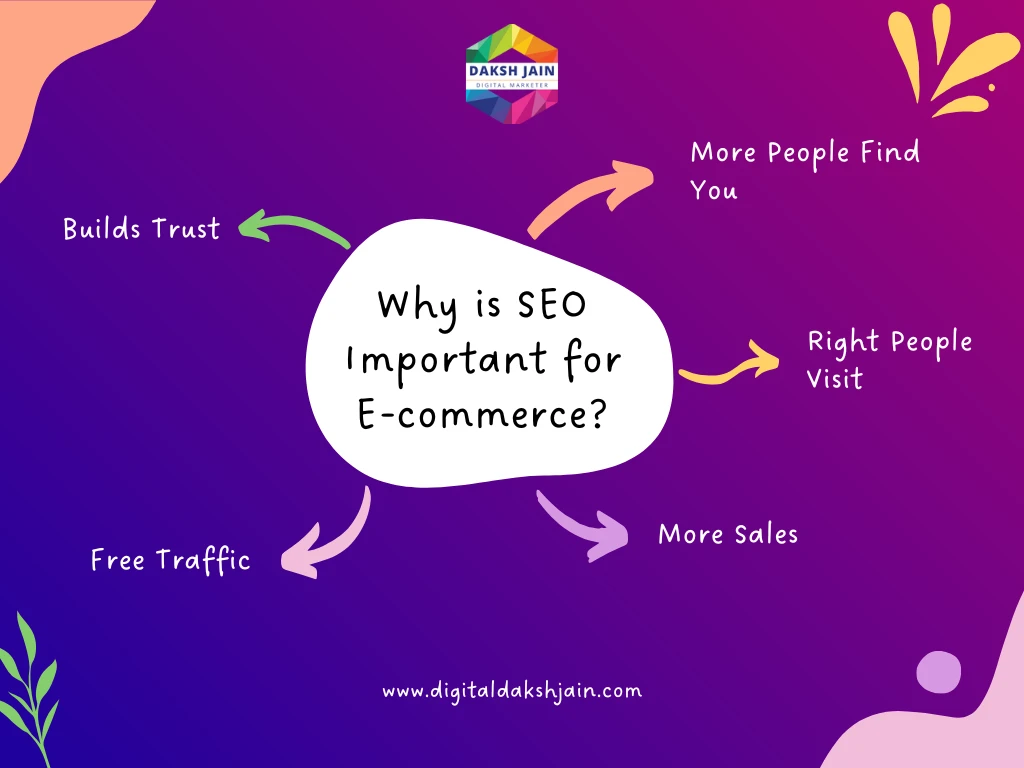
SEO matters for any e-commerce business due to the following reasons:
- More People Find You: Better SEO = higher ranking = more visitors to your store.
- Right People Visit: You reach people who are already searching for what you sell.
- More Sales: More visitors = more chances to sell your products.
- Free Traffic: You don’t have to pay for ads to get visits because SEO brings free traffic over time.
- Builds Trust: People mostly trust websites that show up on the first page of Google.
Example: Imagine you sell handmade candles.
If someone Googles “best soy candles online” and your product page shows up at the top – boom! You just got a potential sale without spending on ads.
4 Key Components of a Strong SEO Strategy for E-commerce Websites
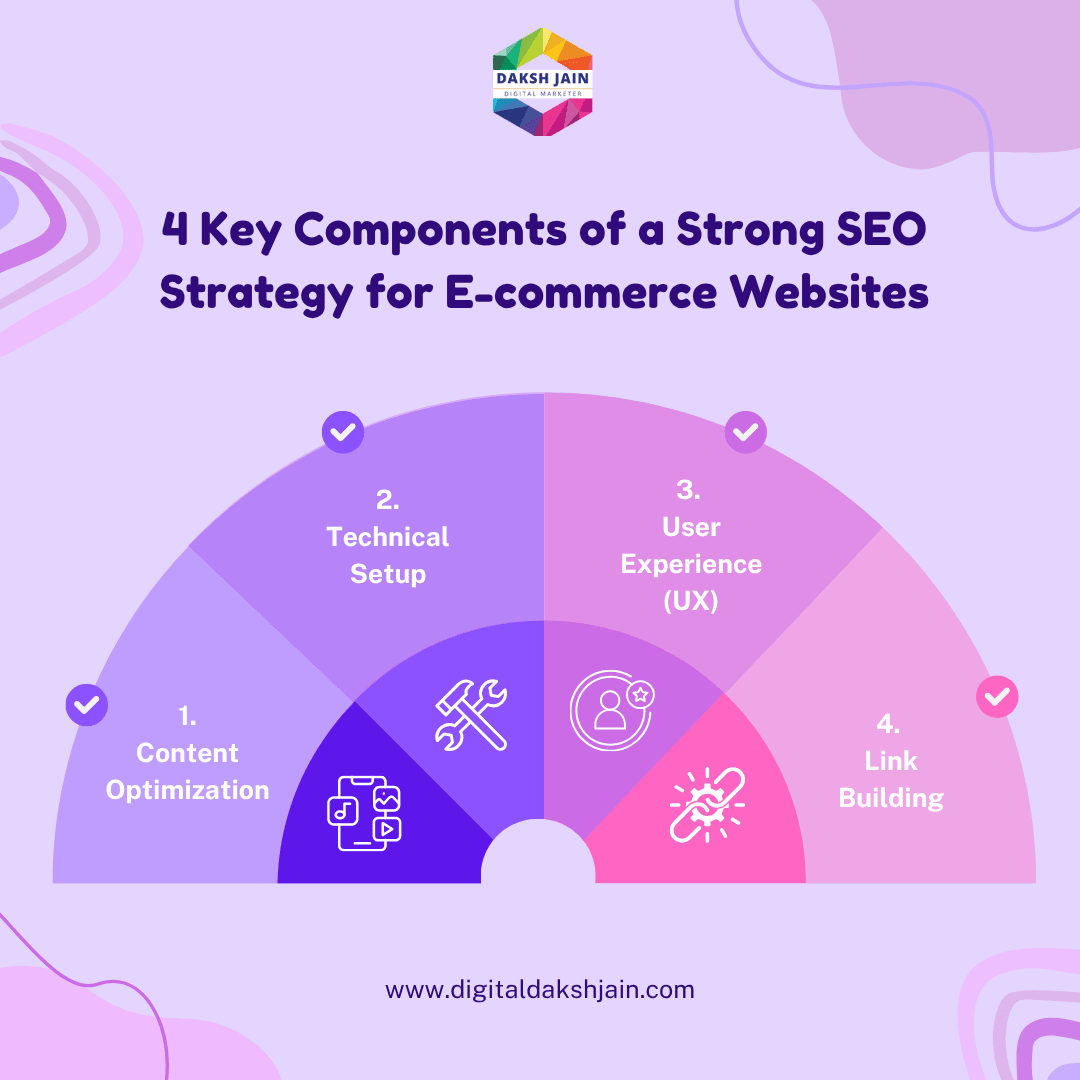
If you run an online store, you already know how important it is to get found on Google. A well-planned SEO for e-commerce strategy can drive organic traffic, increase product visibility, and boost your sales without paid ads.
Here are the 4 key pillars every e-commerce business should focus on:
1. Content Optimization
Your content is the foundation of your SEO success.
To improve your search engine rankings, optimize every important part of your product and category pages with the right search terms.
What to optimize:
- Page URL (use keywords clearly, e.g., /best-leather-wallets)
- Meta title and meta description (include your main keyword)
- H1 headings (make sure there’s only one main headline per page)
- Product descriptions (original, keyword-rich, and helpful)
2. Technical Setup
A fast, clean, and crawlable website is key to SEO success. If search engines can’t properly read or index your site, your rankings will suffer.
What to focus on:
- HTTPS for secure browsing
- Mobile responsiveness (your site should work great on phones)
- Page speed (fast loading = better rankings and user experience)
- XML sitemap (helps Google index your site structure)
- Fix broken links and technical errors
Bonus: Use tools like Google Search Console or Screaming Frog to audit your site.
3. User Experience (UX)
Google wants to give users the best experience possible — so your user experience matters more than ever. A smooth, helpful, and fast website increases time spent on your store and lowers bounce rate, which boosts your SEO.
Key elements Google looks at:
- Time on page (are users staying and reading?)
- Bounce rate (are they leaving too quickly?)
- Conversion rate (are people buying?)
- Navigation & site design (can they easily find what they want?)
If your customers are happy, Google notices and rewards you with better organic rankings.
4. Link Building (Internal & External)
Links are like online votes of confidence. Both internal links (within your site) and external backlinks (from other trusted sites) help build your domain authority, which is crucial for SEO for e-commerce websites.
Your link strategy should include:
- Internal linking (connect related product/category/blog pages)
- External backlinks from blogs, influencers, news outlets, or partners
- Getting featured as a resource on other sites
- Fixing broken backlinks that may hurt your site’s trust
The more quality sites that link to you, the more trustworthy your store looks in Google’s eyes.
How to do SEO for an E-commerce Website?
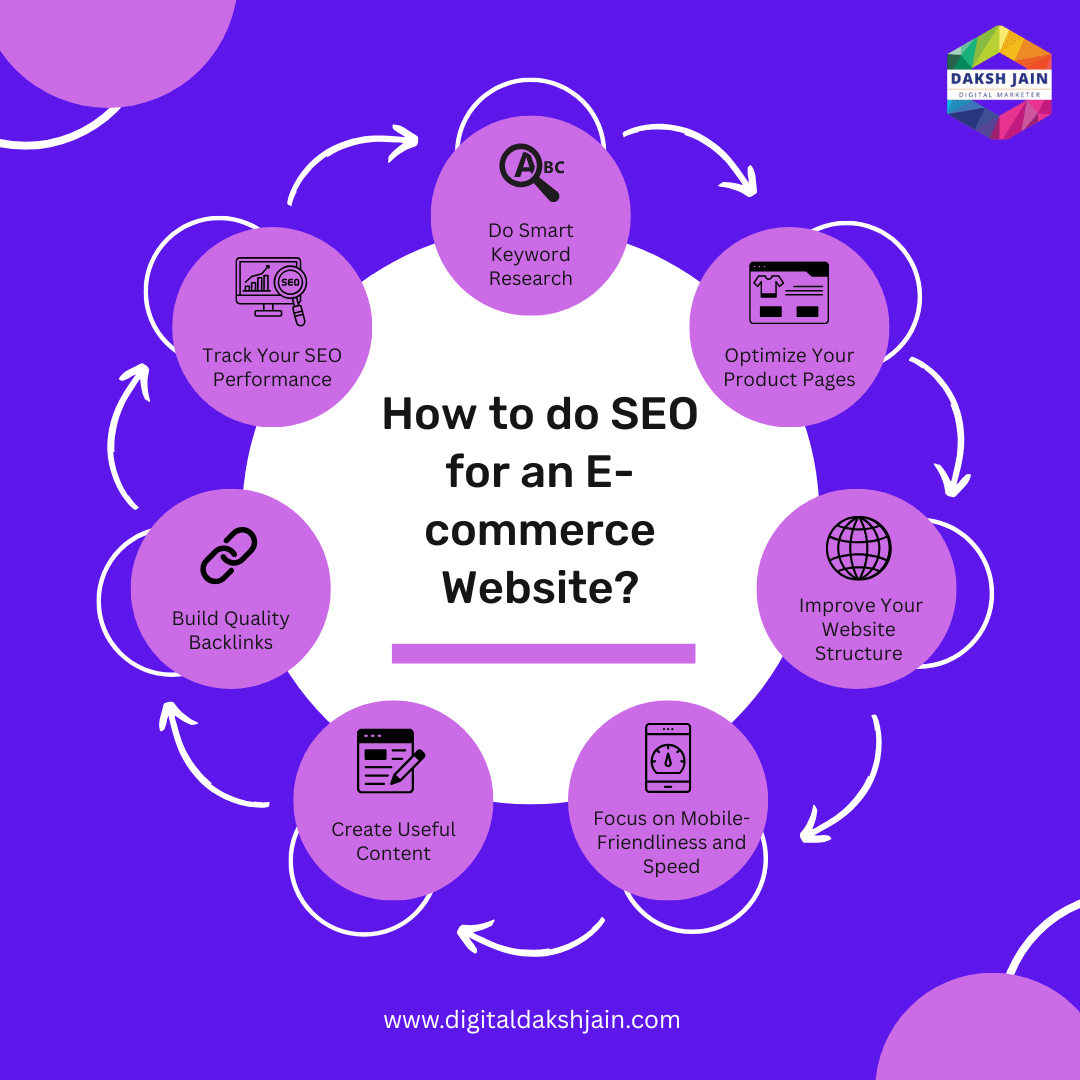
Doing SEO for e-commerce means helping your online store appear higher in Google search results so more people can find and buy your products, without paying for ads.
Here’s a simple, step-by-step breakdown to get started:
1. Do Smart Keyword Research
What are Keywords?
Keywords are the words people type into Google, like “red sneakers for women” or “organic face cream”.
How to Find the Right Keywords
- Use free tools like Google Keyword Planner or Ubersuggest.
- Focus on long-tail keywords (longer, more specific phrases).
- Choose keywords with good search volume but less competition.
2. Optimize Your Product Pages
Tips to Make Product Pages SEO-Friendly
- Use the main keyword in product titles and descriptions.
- Add high-quality images with descriptive file names (e.g., red-running-shoes.jpg).
- Write unique descriptions instead of copying from manufacturers.
- Encourage customer reviews to add fresh content.
3. Improve Your Website Structure
How to Organize Your Site
- Make clear categories (e.g., Shoes > Running Shoes > Women’s Running Shoes).
- Keep important pages within 2-3 clicks from the homepage.
- Create clean, keyword-rich URLs (e.g., yourstore.com/women-red-running-shoes).
4. Focus on Mobile-Friendliness and Speed
Why Mobile and Speed Matter
- Most shoppers are on mobile now.
- Google favors sites that load fast and look good on phones.
How to Improve
- Use a mobile-responsive design.
- Compress images without losing quality.
- Choose a fast hosting provider.
- Check your site’s speed with Google PageSpeed Insights.
5. Create Useful Content
Types of Content You Can Create
- How-to guides (e.g., “How to Pick the Perfect Running Shoe”)
- Product comparisons (e.g., “Best Organic Face Creams in 2025”)
- Tips and tricks related to your products
Blogging brings more visitors and builds trust with your audience.
6. Build Quality Backlinks
What are Backlinks?
Backlinks are links from other websites pointing to your store.
They show Google that your site is trustworthy and valuable.
How to Get Backlinks
- Collaborate with bloggers.
- Partner with influencers.
- Get featured in online magazines.
- Write guest posts on related websites.
7. Track Your SEO Performance
Why Tracking Matters
- See which pages are performing well.
- Understand which keywords are bringing traffic.
- Find and fix weak spots.
Tools to Use
- Google Analytics
- Google Search Console
Tracking helps you improve faster and smarter.
Final Thoughts
SEO for e-commerce might sound tricky at first, but it gets easier once you know the basics.
Start with strong keyword research, create great product pages, optimize for mobile and speed, write helpful content, and build strong backlinks.
Remember: SEO is not a one-time job; instead of it’s an ongoing effort.
Stay patient, stay consistent, and then you will see your online store grow organically!
Frequently Asked Questions (FAQs)
About the Author
Daksh Jain is a freelance Marketing and Digital Marketing Consultant based in Jaipur, India. With expertise in SEO, social media, and content marketing, he helps businesses grow their online presence. Passionate about simplifying marketing strategies, he delivers impactful and results-driven solutions.